
Remember the famous song in the musical Les Misérables?
In Victor Hugo’s novel Les Misérables, the protagonist Jean Valjean is identified by the prison ID number branded on his skin: “24601.” For stealing a loaf of bread, he gets ten years incarceration and ten more for a failed attempt to escape. Valjean’s attempt to define himself became a powerful song in the 1980s, when Claude-Michel Schönberg, Alain Boublil and Jean-Marc Natel created a musical based on Victor Hugo’s novel. Herbert Kretzmer gave it voice in English: “Who Am I?” My family used to go around bellowing those lyrics. Good memories.
Who gets to say who you are? How do you know who am I? How shall I see myself?
If you are a non-speaker with uncontrolled movements, like Owen and his compadres, you get told who you are all the time. Doctors, therapists, parents, siblings, and passers-by paste their labels on you or your intentions, based on what they see. When dysregulated non-speakers learn to control movement enough to spell, they finally have the chance to say, “Nope. That wasn’t what I meant. That isn’t who I am. This is.”
But what about the rest of us? We don’t escape labeling others, or being labeled.
It is a very powerful place to position yourself, to tell someone else who they “are.” Particularly if you combine this with a sense of right and wrong. Not long ago someone told me in a FB chat: “You are a racist.” That was news to me. It certainly didn’t align with any feelings or thoughts that I had or have. I also received one to one messaging like this: “You should not believe what you believe.” Interesting. How can someone know what I should believe, if the person didn’t actually ask me what I do believe?
Or, more significantly, if they didn’t ask why?
Truly a much more interesting question is “Why?” Why as in “Really? Why do you think that/ feel that way? Tell me about it.” Now THAT question leads to deep learning and potentially to some rich relationships. And I have heard that heaven is endless variety, endless varieties of ways of loving good.
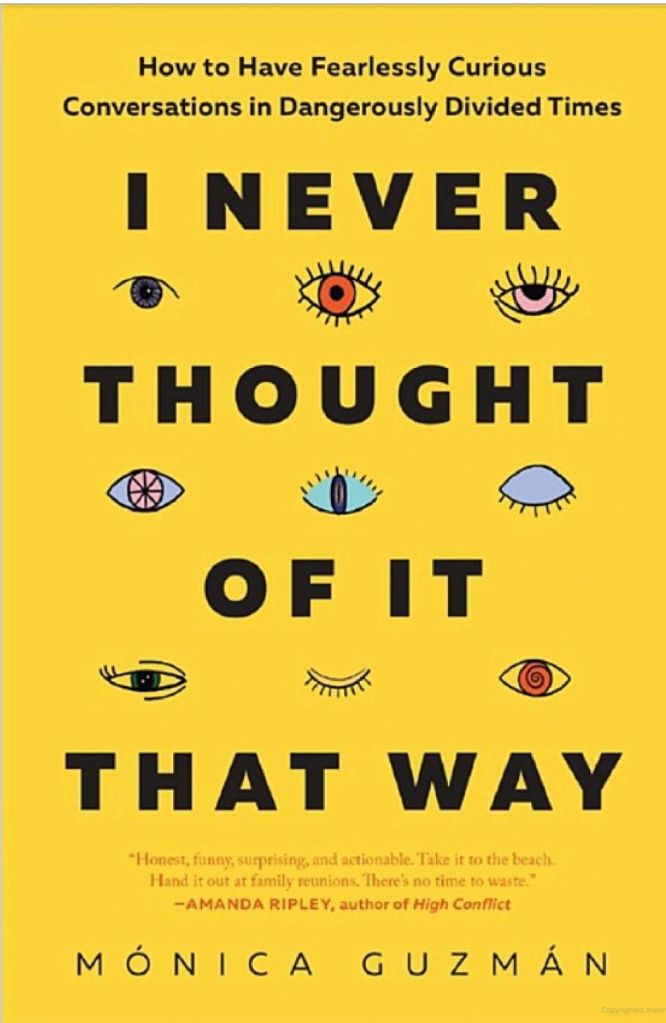
I can’t take credit for either of these ideas though. The first is Mónica Guzmán’s. I first heard her interviewed on NPR, and joyfully ordered her book: I Never Thought of It That Way: How to Have Fearlessly Curious Conversations in Dangerously Divided Times. No surprise that it’s a workbook. It is a delight, and she reads her own book on Audible.
I stole the second thought from the theological writings of Emanuel Swedenborg. He writes about conversations he had with angels in his books Heaven and Hell and Secrets of Heaven, nicely summarized this way by AI in a Google search:
Heaven…is divided into a multitude of communities, each distinguished by the unique qualities of love and faith that define its members. Heaven…is not a fixed state but a continuous journey of growth and perfection. As angels continue to develop in love, wisdom, and use, they progress to higher levels of existence within heaven, characterized by even greater degrees of love, wisdom, and joy. (Google AI)
Sounds pretty good.
There is one catch though, to knowing what to call people, or how to understand who they are, or probably to each of us knowing who we are. To know “why” — why someone is inspired to move in a certain direction, whether it is yourself or someone else — you have to be curious. You have to be curious enough to stop, to listen, and to learn the answer.
Who are you? Who am I?
 Embracing Chaos
Hi Wystan, A really good entry! I’m going to forward this to some in my life who need the encouragement to try different ways of conversing. Hope you all got home safely from the trek. More later, xo AKay
LikeLike
Thanks Aunt Kay! I hope it lead to good things! XO
LikeLike