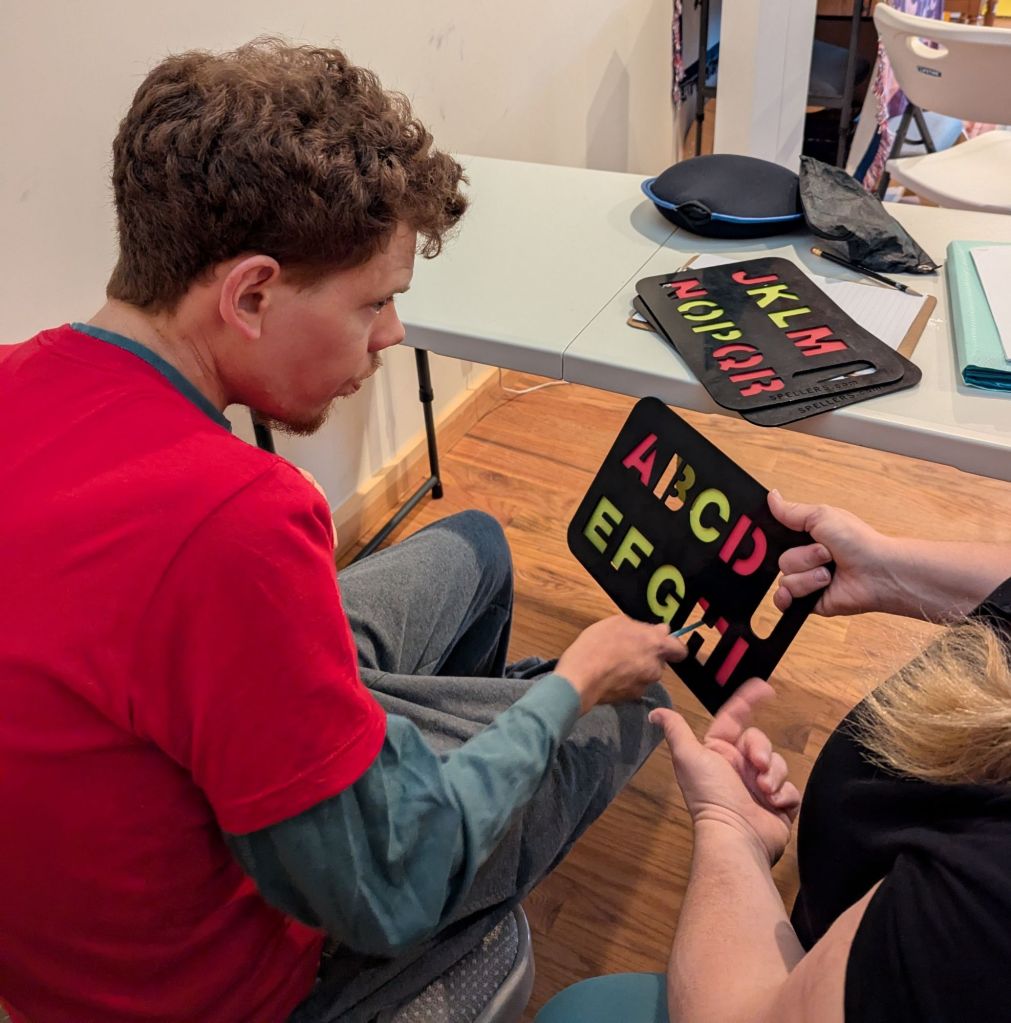
The greatest thing that ever happened to me was learning to spell to communicate, and the second most important thing that happened to me was learning to spell without anyone touching my arm. I never thought that would happen, but then six months ago I began to work with the Spellers Method. I have learned to point at stencil cut out letters with several of my supports and with my dad. The goal is independent commincation, but right now I can only point at letters to repeat a word my support person tells me.
For spellers I hold a stylus and am prompted with words in certain ways, to help open the connction between my brain and my nervous system. I dont get the reverse pressure on my arm that I get with facillitated communication. This was my first method of communication and it has been good. I am glad I have both methods.
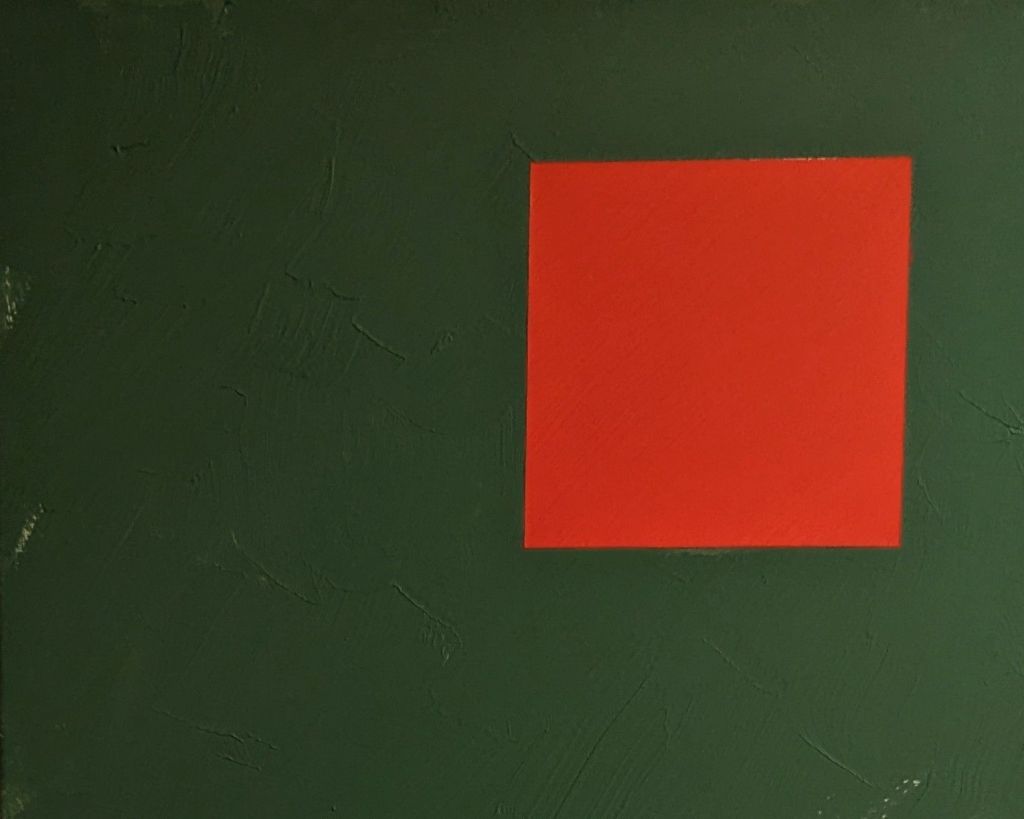
I am learning to control my hand in painting too. That is really important to me. I want to be able to make decisions about the color and shape depending on how the painting is developing, not having to communicate in words first. It seems that it eventually might happen, depending on how much practice I get.
I think that someday there will be an art school that is for non-speakers, even if I have to make it myself. Uoilli* I think that people who talk are amost all terrible listeners. They dont make place in the conversations for a person who types. It isn’t good to be silent when you need to express your thoughts.
I think that we need to find the way to take care of the people with movement regulation problems. We have the worst of all worlds, we are smart people with even crazy bodies. We are dumb but not dumb. We just dont talk. Not speaking does not mean not thinking. I want to even wash the world of that idea, it is not true.
I hope this helps you understand how my communication works. It is frustrating but it is far better than having no voice. I hope you will just give time and make space for the non-speakers in your life. I think they will surprise you with their competence. They give you hope. Love them.
*”Truly”
“The Lord Loving”“The Warm Light of Green” [Publisher’s note: despite best efforts the photo does not capture the artist’s warm green]“Two Are One”
As Owen and I and the dogs tramped back through the darkened woods something made me realize that this was the day. On December 22nd about forty years ago, my mother Marianne left this world suddenly, unexpectedly, the cause an aneurysm that formed in response to the drugs she was taking to combat aggressive cancer.
I had been thinking of mom as we walked over the frosty grass, since there was once a swimming pool there, part of the grounds of the former mansion, and swam there. It’s was her high school classmate’s pool, when she was a dorm student in the Bryn Athyn high school. What had she thought, when she arrived after a long train ride from the Midwest, of this excentric cathedral town full of academics and artists? I know she loved being in the midst of people who loved the arts. And she loved her religion deeply. So maybe she made that transition to a new culture easily, living among many who felt the same, whatever the “clothing” of the culture.
Just before we descended the hill into our yard, I paused and turned to look at the star poised above the lighted Cathedral across the valley. How Mom loved Christmas!. How strange that at the season that she would have traveled home by train for holidays as a teenager, roughly two decades later she left her family to travel home for Christmas in heaven. I bet they really do it up, in heaven.
This year may be the first time, I reflected as I unlatched the back fence gate, that I have not felt an inexplicable detachment come over me as we approach the 22nd. Maybe I have finally outlived that echo.
We were caught unprepared on that night December 1984, in spite of the fact that she was fighting cancer for the second time. A wiser person than myself and my sisters might have realized that we didn’t have very long with her. Her breast cancer had metastasized, and was in her brain, her lungs and her liver and her spleen and we knew that. Then again, we had a dear friend who had been fighting cancer for a decade, I know I was gearing up for that. And then, a state of denial is a powerful amulet against fear. Perhaps that’s why my mother didn’t tell us that she had been given 6 months to live.
Looking at my home from the dark backyard, all lit up and cozy, the wreath of warm red berries on the door (a fake, but a good fake), I smile thinking how she would love that. She would like the big glass windows. And she approved of white Christmas tree lights. How she would enjoy my husband, who also loves Christmas celebration dearly, and is a dedicated decorator in red and green, stringing lights on every bush and tree with Who-like zeal.
Marianne missed so much. And yet tonight she is here, as if she never went away. Outside with me in the December night, and inside where the sound of a brass quartet playing beloved hymns fills the rooms. Beside us on the couch, looking at photos of her grandchildren and great grandchildren, smiling from the walls.
I don’t get visions of angels. I have no proof of the hereafter. I just feel certain things that I know to be true, in my gut. Some (distant) day, it will be my turn to struggle through the pain of a transition, my turn to release a last breath, and leave my tired and broken body behind. I feel certain that Edward and I will always be filling the bushes round our home with lights, bringing in friends and family, singing together. I feel sure that we humans are connected to those we knew, those we know, and to those we will eventually know — in a web of criss-crossing ribbons of joy, that includes my mom.
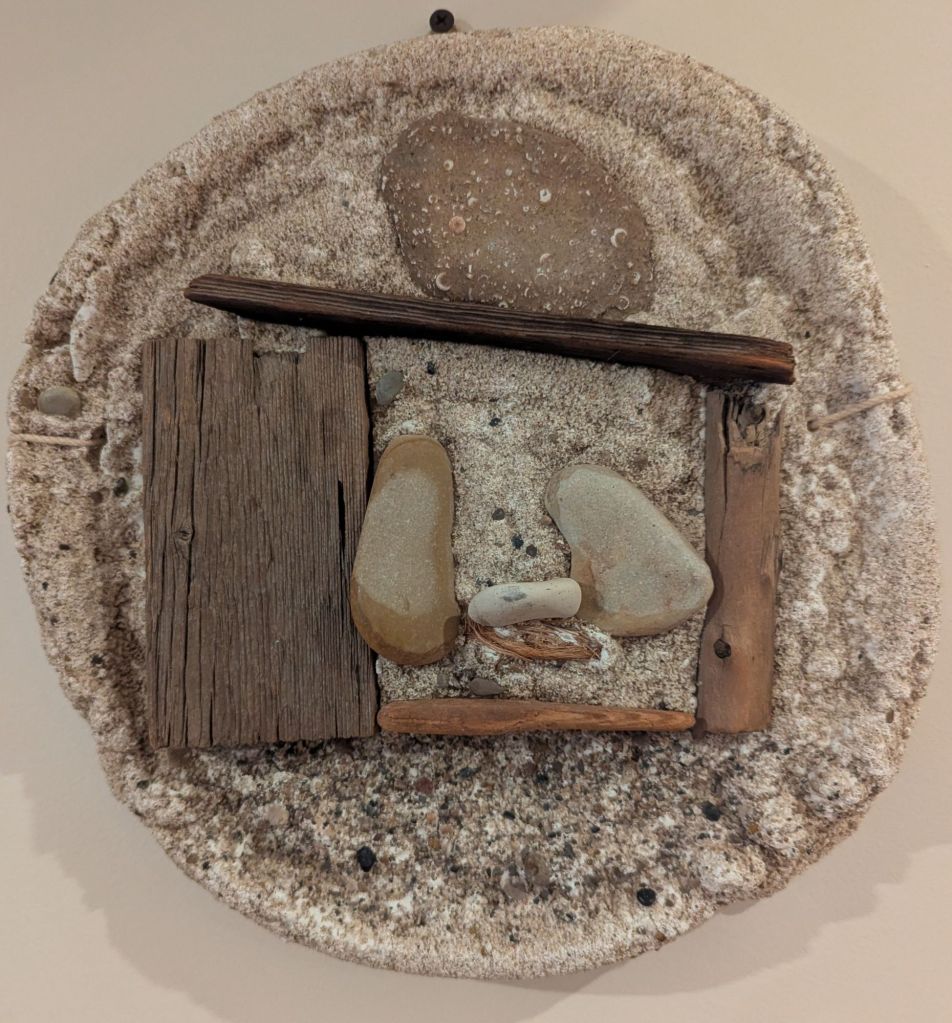
Sandcasting Nativity with found objects, made by Marianne Nicholson Gladish, circa 1968
Remember the famous song in the musical Les Misérables?
In Victor Hugo’s novel Les Misérables, the protagonist Jean Valjean is identified by the prison ID number branded on his skin: “24601.” For stealing a loaf of bread, he gets ten years incarceration and ten more for a failed attempt to escape. Valjean’s attempt to define himself became a powerful song in the 1980s, when Claude-Michel Schönberg, Alain Boublil and Jean-Marc Natel created a musical based on Victor Hugo’s novel. Herbert Kretzmer gave it voice in English: “Who Am I?” My family used to go around bellowing those lyrics. Good memories.
Who gets to say who you are? How do you know who am I? How shall I see myself?
If you are a non-speaker with uncontrolled movements, like Owen and his compadres, you get told who you are all the time. Doctors, therapists, parents, siblings, and passers-by paste their labels on you or your intentions, based on what they see. When dysregulated non-speakers learn to control movement enough to spell, they finally have the chance to say, “Nope. That wasn’t what I meant. That isn’t who I am. This is.”
But what about the rest of us? We don’t escape labeling others, or being labeled.
It is a very powerful place to position yourself, to tell someone else who they “are.” Particularly if you combine this with a sense of right and wrong. Not long ago someone told me in a FB chat: “You are a racist.” That was news to me. It certainly didn’t align with any feelings or thoughts that I had or have. I also received one to one messaging like this: “You should not believe what you believe.” Interesting. How can someone know what I should believe, if the person didn’t actually ask me what I do believe?
Or, more significantly, if they didn’t ask why?
Truly a much more interesting question is “Why?” Why as in “Really? Why do you think that/ feel that way? Tell me about it.” Now THAT question leads to deep learning and potentially to some rich relationships. And I have heard that heaven is endless variety, endless varieties of ways of loving good.
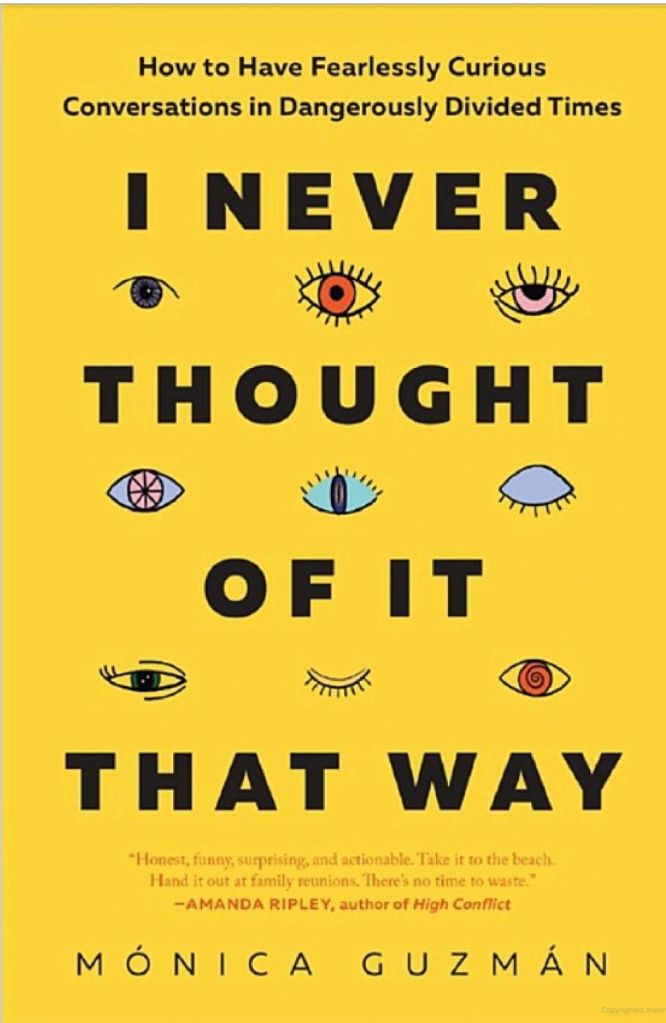
I can’t take credit for either of these ideas though. The first is Mónica Guzmán’s. I first heard her interviewed on NPR, and joyfully ordered her book: I Never Thought of It That Way: How to Have Fearlessly Curious Conversations in Dangerously Divided Times. No surprise that it’s a workbook. It is a delight, and she reads her own book on Audible.
I stole the second thought from the theological writings of Emanuel Swedenborg. He writes about conversations he had with angels in his books Heaven and Hell and Secrets of Heaven, nicely summarized this way by AI in a Google search:
Heaven…is divided into a multitude of communities, each distinguished by the unique qualities of love and faith that define its members.Heaven…is not a fixed state but a continuous journey of growth and perfection. As angels continue to develop in love, wisdom, and use, they progress to higher levels of existence within heaven, characterized by even greater degrees of love, wisdom, and joy. (Google AI)
Sounds pretty good.
There is one catch though, to knowing what to call people, or how to understand who they are, or probably to each of us knowing who we are. To know “why” — why someone is inspired to move in a certain direction, whether it is yourself or someone else — you have to be curious. You have to be curious enough to stop, to listen, and to learn the answer.
“Professor Helen Hale has informed me of a violation of the integrity policy with…assignment[s] in the Foundations of Inquiry class. As a Christian institution of higher education, Cornerstone University seeks to maintain the highest standards of academic integrity, and this incident is a breach of those standards. To uphold our high standards and help you learn from this experience, professors are obligated to report such offences to the Dean’s office… per university policy, Professor Hale will assign you a zero on the assignments in question…”
“Sincerely, Jonathan Marko, Ph.D. Dean, School of Ministry, Media & the Arts”
February 20, 2025
Dear Dean Marko,
I received your letter and was so surprised and disappointed. You punished me without giving me a chance to explain myself. I am an autistic person who has very little control of my movement. The only way that I can focus movement to spell or type is to have someone give me supportive resistance on my arm. It is not possible for me to write without that support. Still I write my own ideas in everything I do.
I cannot speak therefore my mom does for me what I cannot do myself. She probably did too much dedicated calling this time since it seems to have caused more problems. I still do my own thinking and writing. Even if my hands are uncooperative, and my really eyes dont even focus on the thing I am trying to look at, and my body runs away when I need to sit and work, still I do my own work. I have academic integrity.
If this way of writing is not acceptable then I will have to withdraw from the university. I think that the best thing to do is for me to withdraw anyway, since the intense program is too hard for me to keep up, and the ammount of technological assignments is not possible for me to do. I came to Cornerstone University to study religion, which I couldn’t do at community college. It is sad, but I will keep looking for a college that is right for what I need.
Famous stories have been written about parents who had to make painful choices, to keep their children safe. Sophie’s Choice, the blockbuster 1980s film comes to mind. The female protagonist must choose between her two children, forced by a Nazi guard for the purposes of his own amusement. She is made to choose only one child to escape from the train to a concentration camp. (Sophie’s Choice clip) It is hard to watch. It’s like she’s given a test but crumples under the pressure. A non-hero
I would like to think that I would never make such a choice. I would not permit someone to have power over me or my child, to make me do something — to hurt a psyche to save a body.
But life is complicated.
It’s true that everything that Edward and I have done in the past five years on behalf of Owen has been with the purpose of helping him claim his voice. We have pushed back on the nay-sayers, tried to manifest the intelligence that hides under his dysregulated body. Every effort of the organization Real Voices of Philly is for that same purpose: to help ALL non-speakers, as many as we can connect with, to access educational and cultural opportunities. Even if that voice is via the criticized and admittedly imperfect method of pushing through reverse pressure to point at letters on a card or to press keys on a keyboard, to make their thoughts heard.
And yet this month we will ask Owen to betray himself. We have learned that in order to get a waiver for support from the state of Pennsylvania, Owen must subject himself to an IQ test, the soul purpose of which is to prove him incapable of higher thought. Only an autistic who is mentally incapable can receive this financial aid.
I hate it. I hate this ignorant, demeaning law, that forces non- speakers to either misrepresent themselves or to not receive the governmental support that many desperately need. I hate the bullying, officious governmental system that can control lives this way. But the law has the power. Owen and his friends have none. Intensely frustrating as it is the situation will not change quickly. Edward is handling it; I could never bear to do it.
Why need an autist be mentally incapable to receive assistance with their physical disabilities?
Getting this waiver will allow Owen financial support from the federal government, although not enough money to cover his basic needs even for a low quality adult home. Our lawyer says we absolutely must do it. This can provide the basic care, and we can focus on the quality of life stuff, so that he is not medicated into a stupor, left standing in the corner of a group home, twisting plastic in an agony of boredom, 24/7. We already experienced some of this, in the adult daycare Owen endured Maryland. I thought the people were nice… How could I know? And I didn’t know what else to do.
Owen is lucky that we are able to provide the financial support that will make a difference. We plan to provide him trained communication partners (CRPs), that education will continue all his life, including trips to the art museum as well as the hikes that he loves. And hopefully it also provides oversight to prevent abuse or negligence that is rampant in programs and homes.
We have talked about creating a home for a few non-speakers, a group of young men who share Owen’s passion for learning. And then, once that is going, I want to do it again. And again. And again.
Maybe creating safe worlds for these special people — really beautiful homes for people usually assigned the dregs, lives of unexpected cultural richness and dignity — will remove some of the bitterness I feel, at being forced continuously to play by rules that are false measures of reality. Let us break those chains created by ignorant “specialists,” and blind “experts,” chains that hold bright minds in bondage. (Read the novel In Two Worlds by Ido Kedar. You will be glad you did).
Owen writes: “It is sad that we have to lie to get the help we need.”
Thank God for those who are curious, who ask questions, who want to know. Because the true measure of a human being is a difficult measurement to get.
Post Script:
This post is dedicated to my uncle, Robert A. Smith of Glenview Illinois, who passed away on January 16, 2024. He was a man who looked for a way to connect with people, to lift people up. It seems that he tried to make the world a little brighter, either by a word or deed, for anyone he came across. I didn’t know my uncle very well, and I would have said that we were very different sorts of people. But as I finish this post, I recognize him as a mentor. Bob Smith’s generosity, his rather intense commitment to making the world a better place, and his willingness to roll up his sleeves and “do something about it” are a powerful role model in POSSIBILITY. With gratefulness — I had no idea how much I owe you until you were gone.
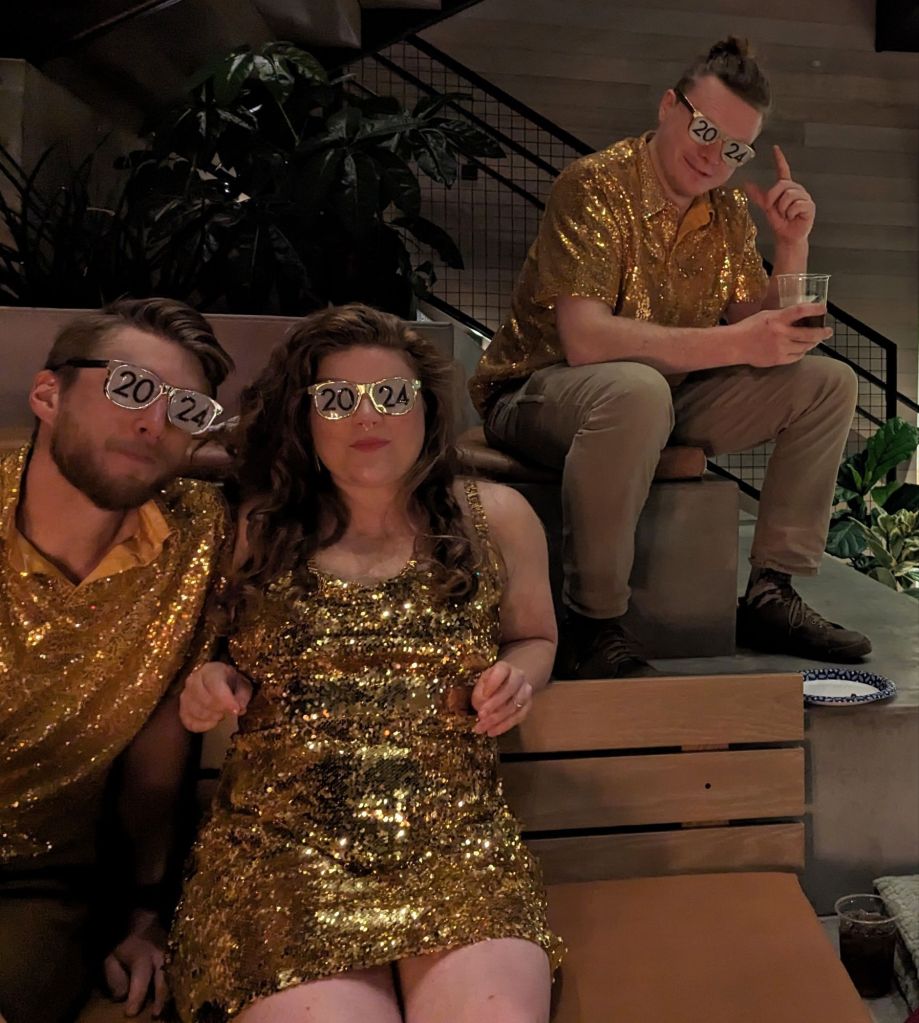
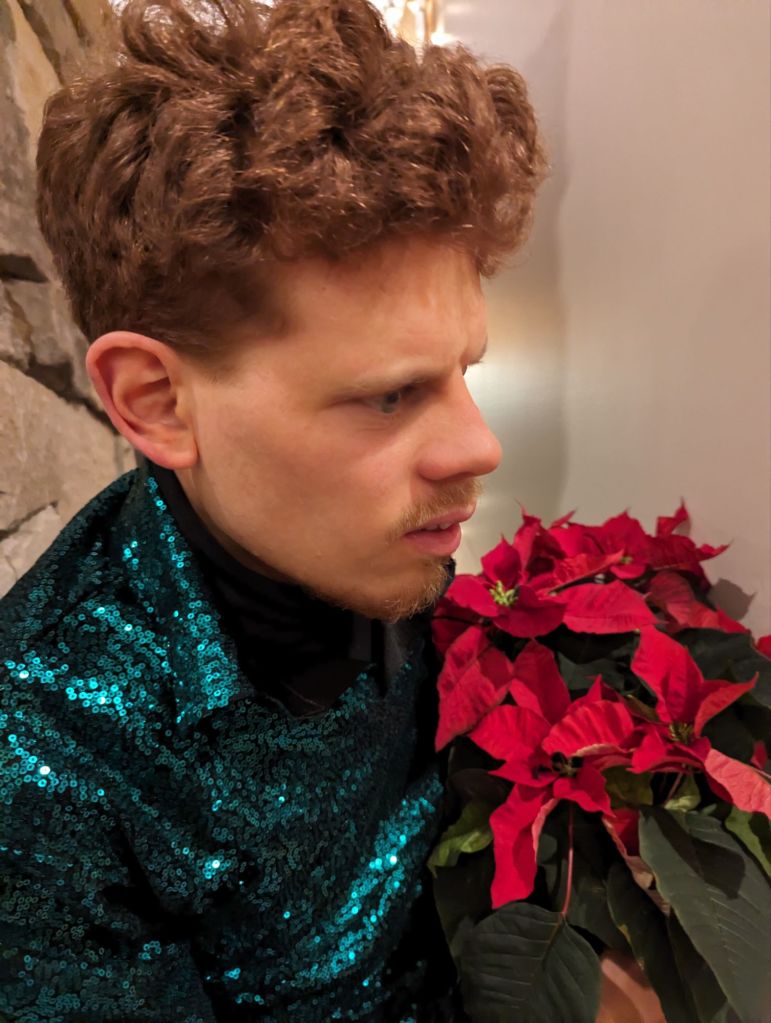
It is night. The last night of three nights of parties for Meagan and Sam’s wedding. The last night of 2023. I am wearing a green sequin shirt; sequins like the rest of my family. I am eating wonderful dessert made of chocolate. The room is full of loud laughter and naked women who are wearing pretty dresses that show too much. The guys are dressed up too, just looking good. There is a music room and bar upstairs. Downstairs there tables and chairs set up for visiting. There is food, a long table full of meats, nuts, fruits, dips, cheeses and crackers.
Then we are all hurrrying upstairs for the ball drop at midnight. Loud music hurts my ears but this is the place I want to be. There is dancing, and toasting champagne and people having fun and being really loud! I feel happy to be there and to be seen by just so many cousins and friends. Great good times! Then we go back to the hotel and to go to sleep. The love of Meagan and Sam has created three nights of love for family.
Last week Owen started his college journey. When it became obvious that RealVoices of Philly is not yet ready to fill Owen’s longing for education, we got brave enough to dive in. It helped that this past June at a convention we listened to a panel of typers and spellers from across America and Canada who were doing the same thing. So, I reached out to Harvard Extension and then (more affordably) to Montgomery Community College. I am still amazed that this long-held wish could come true.
As I searched and struggled with the online systems, Owen and I were both kind of anxious. But I hide it better. Owen was freaking out (admit it O), tearing up paper and driving me nuts. What a strange situation people with disrupted movement are in, that their bodies so COMPLETELY betray them. So that even those who love them, and who KNOW the mind behind the madness, can feel confused. Angry. You want to say, “Act like who you really are!!!” Sometimes you do say it. Which is no help at all. And totally unfair.
It’s like saying “Duh! Don’t be blind! Just open your eyes!!”
It turned out that we were registering at the last minute. I couldn’t work the online registration system at first.
The first class was actually last week. Mom messed up. But Owens professor is amazing, very bright and still very supportive. By now the readings are mostly read first there week, and there is just the discussion board posting to make. And Owen is smiling. A lot.
How did he feel this morning, after a late night working on his first short essay for the group discussion board? “Tired, but happy.”
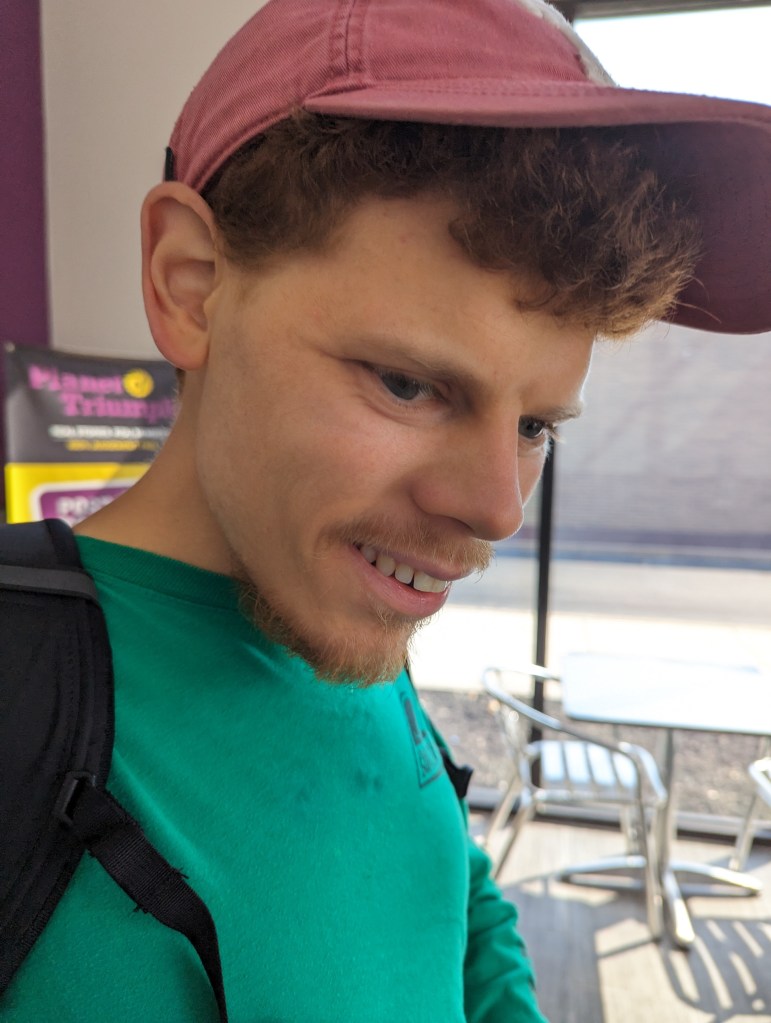
Owen and I made it almost on time for church. This small victory was more impressive since Edward was away, and I was doing things solo. Nevertheless, Owen did not like walking in late, and at first I thought we wouldn’t be able to stay, as his embarrassment manifested through his body. We both stayed tense, sitting on the edge of our chairs, backpacks on. It didn’t help that today’s minister was different.
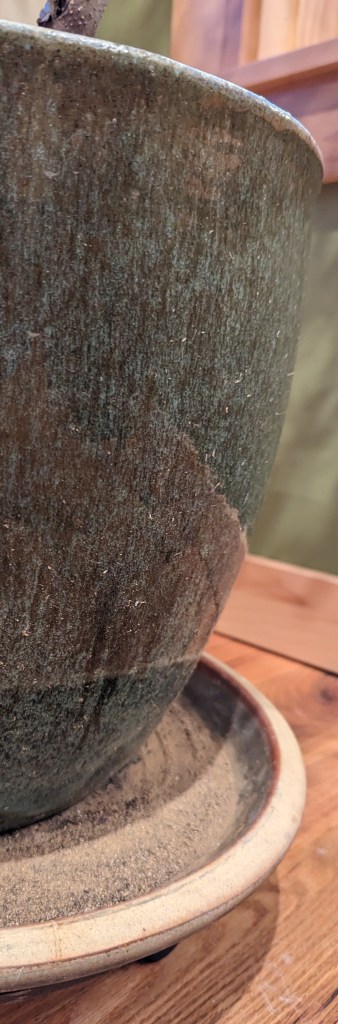
But the visiting minister was chill. And he had engaging things to say. Owen was able to override the anxiety-that-becomes-hitting, pulled it together, and we followed the unspooling of thoughts. Asked to picture an object that might be seen as carrying a message to me of something deeper, I studied a large ceramic planter on the floor near the window. It looked just like the kind of thing that Edward would tell me not to try to move by myself. It stood on a rolling tray.
I studied that pot, feeling certain that the massive form held something for me to get.
So many things in my life feel so very heavy. The challenges before me feel insurmountable, frightening. That’s if I peer in at my inner self. Usually I keep that door closed, just keep threading my way across the chasm on the swinging rope bridge, and don’t look down. The day to day challenges of assisting a person who needs a great deal of support to get through life can be fatiguing, but that isn’t it. It’s the larger question of how to keep our educational organization Real Voices of Philly (realvoicesphilly.org) alive and independent, and how to create a home for Owen with a small group of typers and spellers, so he can age with friends. Able to communicate his thoughts. Able to do his writing. Funded. Cared for kindly. Safe from predators….
I have no idea how to do those things. I never got training in those things, and more than that, it isn’t what I wanted to do with my life. I know that as Edward and I are setting it up we will be told over and over “that is too heavy for you” and “you can’t/aren’t allowed to do that.”
And the other truly frightening thing – what if my partner in crime, who understands the financial side of the undertaking so much better than I, moves out of this world before we figure it out? How can I possibly navigate this enormous problem solo? (As I am writing this I can feel my blood pressure rise.)
The huge heavy pot sits on a little tray with casters. I don’t remember what was growing in it. I visualize the big clay pot. Something that the minister says reminds me of the history of the wheel – an ancient invention. One of the earliest. A way to carry very heavy objects that has been with us for a long, long time. The tool is there. It is literally right underneath, waiting to be put to use.
Sitting in that room, on the edge of my chair with my backpack on and waiting for Owen to fall apart, I take a deep breath. I believe this pot’s message. What I need to carry my burden is already there. It is under my feet. Start with this room of caring individuals, and the two ministers who lead the group – they all make a space for Owen, and are interested in his thoughts.
And in my life this spring, it is true – remarkable things have happened. People I never dreamed existed have shown up in our lives. Ever since we moved to the Philadelphia area people have arrived seemingly out of nowhere. Even though we spent many days of terrible anxiety or exhaustion, uncertain we could keep it up, actually helpers did arrive. This fall even more people have come out of nowhere, enthusiastic for the mission, presuming without difficulty the intelligence of our non-speakers. Wanting to learn to support communication. Able to take in stride and with compassion the behaviors that autism brings.
Not really out of nowhere. I had to ask. I had to push against the weight – reach out for help. Write a message, find time to follow up. Sometimes ask again. Organize my life better, organize my thoughts. Write a proposal to be able to ask more specifically. I had to talk people through things. Let go of some things.
But, I am not alone. There are now other parents, other students, more teachers, and helpers, aides for just Owen and also for the organization that gives him something meaningful to do with his life. That prayer that I used to say, that if this was meant to happen then it would be you God doing it, because I couldn’t, I couldn’t, I couldn’t possibly do this lift…that prayer seems to be answered. Maybe it IS meant to be.
Because now I see that the heavy pot once rolling, could take new form, could transform. Become a huge hot air balloon lifting the weighty basket of beloved people. Fueled properly, perhaps it rises, independent, airborn, and floats slowly upward, while I shade my eyes watching, in awe.
Written in the camper, on the return drive from Treasure Island, FL. March 2023
On this morning, just before we left, Owen spun out of the beach house at an early hour – I found him just down the road, at the center of police cars and ambulances. He was unhurt, but had things to say.
Wystan: Want to spell or to type?
Owen: “Sp”
Owen: “That was frustrating when the police got my hands and put those handcuffs on my wrists.”
W: They seemed like pretty nice guys to me. What do you wish would have happened differently?
O: ” I wish they would only use handcuffs if a person is not listening.”
W: Maybe he thought you weren’t listening? Maybe that’s what they just do for everyone who looks like a robber? Until they know better?
[Owen pulls the card out of my hands, sets it down and won’t talk]
O: “I was not a dangerous person. I was eating their– ” [disrupted movement, small smile]
W: Yeah, what WERE you eating btw?
O: “- their cookies. And chocolate.”
W: Sometimes people are on drugs, and do very strange things, like that guy Dad saw on the beach. But also could be suddenly violent. I am guessing the police see stuff like that. They don’t know what might happen.
O: “It hurts my feelings [bang, bang, bang] that they would think–”
[Big meltdown here]
W: We don’t know what they think. I’m just trying to help you see the situation through other people’s eyes, to help you understand what you experienced.
Would you like to keep processing this?
O: “Y”
W: If you were a policeman, called to a situation like that, seeing a guy in someone’s kitchen early in the morning, a guy who did not speak or answer questions, what would you do? What would you like police people to know about how to handle non-speakers?
O: “I would not have the handcuffs out. I would stay calm and I guess I wish I could talk.
W: Do you mean you wish the police people knew that you wished you could talk?
O: “Yes. Every day every minute of every hour.”
[After a break]
W: So what happened when you got up out of bed this morning?
O: “I was worried about getting into the kitchen again so I went out because that door is easy to open.”
W: I have a question about that. Is it true that you are trying not to break through the locks that we put up? Like do you know how to open them, but you’re trying not to open them? How come you can open things sometimes, but not other times?
O: “Because sometimes it is harder to make my body listen” [Owen starts laughing]. “Sometimes I want–” [more laughing]
W: Does your laughing really mean laughing right now?
O: “Y”
O: [he continues laughing] “–to get out. And most times –”
[Owen pulls the card away from me and sets it down.]
[Next day]
W: Do you want me to start w a question?
O: N
[Owen continues to move and sort plastic bags]
W: Would you like to ask me a question?
O: It is hard to write because we have been going so long in the camper that it makes me feeel really deterred from moving.
W: Interesting choice of words. Seems like there’s so little we know about dysregulated movement, or why there would be this separation of cognitive function from muscular function.
O: Yes. I have very little real control of my body.
[Next day]
W.: Could you describe how getting resistance, or resistive pressure, helps you?
O: it is like havinbg really the wonderful feeling of moving your arm the way you mean it to go. i feel like i cant move.
W: Yes, I have seen you get stuck. But sometimes you move very fast, too.
O: i have a hard time with both things . how to not move is just as hard as moving.
W: Here is part of a conversation that we had a while ago, on this same subject:
W: Do you remember the time before May 2018, before you first spelled?
O: yes i do. it was reallly terrible. i would standn at the counter and no one couuld ask what i wanted. to eat.
W: Do you remember being fed foods that you did not want to eat?
O: yes it happened a loyt [lot]. i hated eggs and green pepers, and yoiu gzagve them to me so many times. they made me sick. i hafd sto,macnh avchdes [aches].
W: Yeah, I remember that you would burp a lot, getting on the school bus. I thought I was giving you a sturdy breakfast. Some people might not understand why you would eat something, if you disliked it so much.
O: i wsas hungry and you did not give me another fchoice but if you gave me eggs today i would still eat them, beca8use i cannnt sgtop mysrrelggfg [myself]. my body iis not able to stop eating whatever i see .
W: Thanks for providing these insights O. Do you have any last thoughts?
O: it matters that we non-speakers have a voice in the world. the world does not believe that we reallllly are thinking people…but we have brains trapped inside bodies that act crazy. people need to get to even know us.
♥️ ♥️ ♥️ ♥️ ♥️
Owen’s words are literally, word for word, letter for letter, what he spelled out. When he was spelling on a letterboard (in the moving camper), I transcribed it so it is in standard spellings and capitalizations. When he was typing on his keyboard the text is as he typed it. As he describes, when getting started, or tired, or in a state of high emotion, he has a much harder time with accuracy, and even staying in the chair at all. It is a great effort – and I feel so lucky to know him, and all the other wonderful young people who spell and type who have come into our lives. This interview took place over several days.
For more on this subject, read Owen’s post about getting into garbage: “Pica Hell” January 27, 2020
RealVoices is the sound of wonderful things developing. It began as a four person group of friends last spring. Today it is a group of five or six and the day is 10 to 3pm. We love to have each other to learn with, and to talk to. We love hearing each others ideas. We focus on our ideas We get to forget our bodies.
The Andes mountains are yearning to speak. How you hear them really is the question.
The real business of RealVoices is finding every real voice, and delivering it. Not everyone will see the person behind the disrupted movement, but there are those who do.
Fortunately there are the ones who do.
OWEN’S DRAFTS
Owen and I thought it would be useful for readers to see some of his process.
Like any other writer, Owen begins his work with a rough draft where the main goal is just to keep the words coming. There are lots of insurance movements, so spelling mistakes. Owen often uses repeat letters for emphasis, as well. But he is pretty conservative about his final drafts. All his words are always his own, and any edits as well. (Mom might think she can guess where it’s going, but no!) To edit we set the tablet side by side with the keyboard. Owen touches the laptop screen to get the general vicinity and fine tunes with laborious use of the cursor. As a one fingered writer, to capitalize he hits “caps lock” – so he does all his caps at one time.
Original draft Dec 13
the realvoiced fakk sesssion realvoicves is the sound ooooof wonderful things developing. it began as a fourrrr person group of friends last sprinfg. today. it is a group of five or six and the day is 10 to 3pm. we love to have each other to learn with, and to talkto. we love hearing each others ideas. we forcus on our ideas we get to forget our bodies. the andes mountains are yearning to speak .how you even. hear. them really is the question.
the realbuusiness of real voices is finding every real voice, and delivering it. not everyone will see the perssson behind t
Owen’s Dec 18 edit
the RealVoices Fall Session
RealVoices is the sound of wonderful things developing. It began as a four person group of friends last spring. Today it is a group of five or six and the day is 10 to 3pm. We love to have each other to learn with, and to talk to. We love hearing each others ideas. We forcus on our ideas We get to forget our bodies.
The andes mountains are yearning to speak .how you even. hear. them really is the question.
the realbuusiness of real voices is finding every real voice, and delivering it. not everyone will see the perssson behind the dysrupted movement, bbut
Owen’s Dec 21 edit
the RealVoices Fall Session
RealVoices is the sound of wonderful things developing. It began as a four person group of friends last spring. Today it is a group of five or six and the day is 10 to 3pm. We love to have each other to learn with, and to talk to. We love hearing each others ideas. We forcus on our ideas We get to forget our bodies.
The Andes mountains are yearning to speak. How you hear them really is the question.
the realbuusiness of real voices is finding every real voice, and delivering it. not everyone will see the perssson behind the dysrupted movement, bbut there arde thosee who do. to
What is Supported Communication?
“Supported Communication” means resisting the typer’s forward movements, which stabilizes and focuses their efforts to make the controlled movements necessary to spell out their thoughts. Writing, for those with disrupted or dysregulated movement is hard, requiring alot of patience, effort, and time. Many individuals experience movement dysregulation, those with autism and cerebral palsy among many other illnesses that affect ability of the brain to control the nervous system.
Correctly practiced, supporting communication never involves directing the communicator’s hand, nor guessing, or “helping” – it is just resistive pressure. The tablet/laptop or letter board remains stationary. If it is unclear whether the communicator’s movement is purposeful or non-purposeful that is dysregulated, or being influenced by the support, the support will come back to a neutral position to allow the communicator to start over again on a path toward a desired letter.
For more information about supported communication, check out the website and contact info at realvoicesphilly.com.












 Embracing Chaos