
Who Am I?

24601

Remember the famous song in the musical Les Misérables?

In Victor Hugo’s novel Les Misérables, the protagonist Jean Valjean is identified by the prison ID number branded on his skin: “24601.”  For stealing a loaf of bread, he gets ten years incarceration and ten more for a failed attempt to escape.  Valjean’s attempt to define himself became a powerful song in the 1980s, when Claude-Michel Schönberg, Alain Boublil and Jean-Marc Natel created a musical based on Victor Hugo’s novel. Herbert Kretzmer gave it voice in English: “Who Am I?” My family used to go around bellowing those lyrics. Good memories.

Who gets to say who you are? How do you know who am I? How shall I see myself?

If you are a non-speaker with uncontrolled movements, like Owen and his compadres, you get told who you are all the time. Doctors, therapists, parents, siblings, and passers-by paste their labels on you or your intentions, based on what they see. When dysregulated non-speakers learn to control movement enough to spell, they finally have the chance to say, “Nope. That wasn’t what I meant.  That isn’t who I am. This is.”

But what about the rest of us?  We don’t escape labeling others, or being labeled.

It is a very powerful place to position yourself, to tell someone else who they “are.” Particularly if you combine this with a sense of right and wrong.  Not long ago someone told me in a FB chat: “You are a racist.”  That was news to me. It certainly didn’t align with any feelings or thoughts that I had or have. I also received one to one messaging like this: “You should not believe what you believe.” Interesting. How can someone know what I should believe, if the person didn’t actually ask me what I do believe?

Or, more significantly, if they didn’t ask why?

Truly a much more interesting question is “Why?”  Why as in “Really? Why do you think that/ feel that way? Tell me about it.” Now THAT question leads to deep learning and potentially to some rich relationships. And I have heard that heaven is endless variety,  endless varieties of ways of loving good.

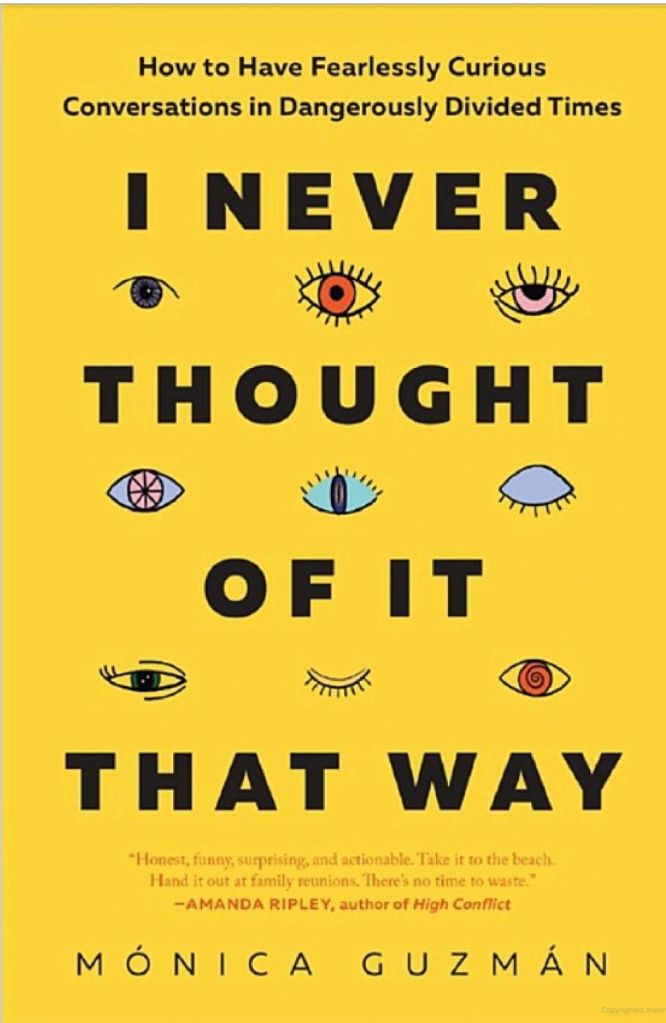
I can’t take credit for either of these ideas though. The first is Mónica Guzmán’s. I first heard her interviewed on NPR, and joyfully ordered her book: I Never Thought of It That Way: How to Have Fearlessly Curious Conversations in Dangerously Divided Times. No surprise that it’s a workbook. It is a delight, and she reads her own book on Audible.

I stole the second thought from the theological writings of Emanuel Swedenborg. He writes about conversations he had with angels in his books Heaven and Hell and Secrets of Heaven, nicely summarized this way by AI in a Google search:

Heaven…is divided into a multitude of communities, each distinguished by the unique qualities of love and faith that define its members. Heaven…is not a fixed state but a continuous journey of growth and perfection. As angels continue to develop in love, wisdom, and use, they progress to higher levels of existence within heaven, characterized by even greater degrees of love, wisdom, and joy. (Google AI)

Sounds pretty good.

There is one catch though, to knowing what to call people, or how to understand who they are, or probably to each of us knowing who we are.   To know “why” — why someone is inspired to move in a certain direction, whether it is yourself or someone else — you have to be curious. You have to be curious enough to stop, to listen, and to learn the answer.

Who are you?  Who am I?
Move It

By Owen and Wystan 

Written in the camper, on the return drive from Treasure Island, FL. March 2023

On this morning, just before we left, Owen spun out of the beach house at an early hour – I found him just down the road, at the center of police cars and ambulances. He was unhurt, but had things to say.

Wystan: Want to spell or to type?  

Owen:  “Sp”

Owen: “That was frustrating when the police got my hands and put those handcuffs on my wrists.”

W: They seemed like pretty nice guys to me. What do you wish would have happened differently?

O: ” I wish they would only use handcuffs if a person is not listening.”

W: Maybe he thought you weren’t listening? Maybe that’s what they just do for everyone who looks like a robber? Until they know better?

[Owen pulls the card out of my hands, sets it down and won’t talk]

O: “I was not a dangerous person. I was eating their– ” [disrupted movement, small smile]

W: Yeah, what WERE you eating btw?

O: “- their cookies. And chocolate.”

W: Sometimes people are on drugs, and do very strange things, like that guy Dad saw on the beach. But also could be suddenly violent. I am guessing the police see stuff like that. They don’t know what might happen.

O: “It hurts my feelings [bang, bang, bang] that they would think–”

[Big meltdown here]

W: We don’t know what they think. I’m just trying to help you see the situation through other people’s eyes, to help you understand what you experienced.

Would you like to keep processing this?

O: “Y”

W: If you were a policeman,  called to a situation like that, seeing a guy in someone’s kitchen early in the morning, a guy who did not speak or answer questions, what would you do? What would you like police people to know about how to handle non-speakers?

O: “I would not have the handcuffs out. I would stay calm and I guess I wish I could talk.

W:  Do you mean you wish the police people knew that you wished you could talk?

O: “Yes. Every day every minute of every hour.”

[After a break]

W: So what happened when you got up out of bed this morning?

O: “I was worried about getting into the kitchen again so I went out because that door is easy to open.”

W: I have a question about that. Is it true that you are trying not to break through the locks that we put up? Like do you know how to open them, but you’re trying not to open them? How come you can open things sometimes, but not other times?

O: “Because sometimes it is harder to make my body listen” [Owen starts laughing]. “Sometimes I want–” [more laughing]

W: Does your laughing really mean laughing right now?

O: “Y”

O: [he continues laughing]  “–to get out. And most times –”

[Owen pulls the card away from me and sets it down.]

[Next day]

W: Do you want me to start w a question?

O: N 

[Owen continues to move and sort plastic bags]

W: Would you like to ask me a question?

O: It is hard to write because we have been going so long in the camper that it makes me feeel really deterred from moving.

W: Interesting choice of words. Seems like there’s so little we know about dysregulated movement, or why there would be this separation of cognitive function from muscular function.

O: Yes. I have very little real control of my body. 

[Next day]

W.: Could you describe how getting resistance, or resistive pressure, helps you?

O: it is like havinbg really the wonderful feeling of moving your arm the way you mean it to go. i feel like i cant move.                                

W: Yes, I have seen you get stuck. But sometimes you move very fast, too.

O: i have a hard time with both things .  how to not move is just as hard as moving.

W: Here is part of a conversation that we had a while ago, on this same subject:

W: Do you remember the time before May 2018, before you first spelled?

O: yes i do. it  was reallly terrible. i would standn  at the counter and no one couuld ask what i wanted. to eat.  

W: Do you remember being fed foods that you did not want to eat? 

O: yes it happened a loyt [lot]. i hated eggs and green pepers, and yoiu gzagve them to me so many times. they made me sick. i hafd sto,macnh avchdes [aches]

W: Yeah, I remember that you would burp a lot, getting on the school bus. I thought I was giving you a sturdy breakfast.  Some people might not understand why you would eat something, if you disliked it so much.

O: i wsas hungry and you did not give me another fchoice but if you gave me eggs today i would still eat them, beca8use i cannnt sgtop mysrrelggfg [myself].  my body iis not able to stop eating whatever i see .

W: Thanks for providing these insights O. Do you have any last thoughts?

O: it matters that we non-speakers have a voice in the world. the world does not believe that we reallllly are thinking people…but we have brains trapped inside bodies that act crazy. people need to get to even know us.

♥️ ♥️ ♥️ ♥️ ♥️

Owen’s words are literally, word for word, letter for letter, what he spelled out. When he was spelling on a letterboard (in the moving camper), I transcribed it so it is in standard spellings and capitalizations. When he was typing on his keyboard the text is as he typed it. As he describes, when getting started, or tired, or in a state of high emotion, he has a much harder time with accuracy, and even staying in the chair at all. It is a great effort – and I feel so lucky to know him, and all the other wonderful young people who spell and type who have come into our lives.  This interview took place over several days.

For more on this subject, read Owen’s post about getting into garbage: “Pica Hell” January 27, 2020

https://embracingchaos.net/2020/01/