“Professor Helen Hale has informed me of a violation of the integrity policy with…assignment[s] in the Foundations of Inquiry class. As a Christian institution of higher education, Cornerstone University seeks to maintain the highest standards of academic integrity, and this incident is a breach of those standards. To uphold our high standards and help you learn from this experience, professors are obligated to report such offences to the Dean’s office… per university policy, Professor Hale will assign you a zero on the assignments in question…”
“Sincerely, Jonathan Marko, Ph.D. Dean, School of Ministry, Media & the Arts”
February 20, 2025
Dear Dean Marko,
I received your letter and was so surprised and disappointed. You punished me without giving me a chance to explain myself. I am an autistic person who has very little control of my movement. The only way that I can focus movement to spell or type is to have someone give me supportive resistance on my arm. It is not possible for me to write without that support. Still I write my own ideas in everything I do.
I cannot speak therefore my mom does for me what I cannot do myself. She probably did too much dedicated calling this time since it seems to have caused more problems. I still do my own thinking and writing. Even if my hands are uncooperative, and my really eyes dont even focus on the thing I am trying to look at, and my body runs away when I need to sit and work, still I do my own work. I have academic integrity.
If this way of writing is not acceptable then I will have to withdraw from the university. I think that the best thing to do is for me to withdraw anyway, since the intense program is too hard for me to keep up, and the ammount of technological assignments is not possible for me to do. I came to Cornerstone University to study religion, which I couldn’t do at community college. It is sad, but I will keep looking for a college that is right for what I need.
Famous stories have been written about parents who had to make painful choices, to keep their children safe. Sophie’s Choice, the blockbuster 1980s film comes to mind. The female protagonist must choose between her two children, forced by a Nazi guard for the purposes of his own amusement. She is made to choose only one child to escape from the train to a concentration camp. (Sophie’s Choice clip) It is hard to watch. It’s like she’s given a test but crumples under the pressure. A non-hero
I would like to think that I would never make such a choice. I would not permit someone to have power over me or my child, to make me do something — to hurt a psyche to save a body.
But life is complicated.
It’s true that everything that Edward and I have done in the past five years on behalf of Owen has been with the purpose of helping him claim his voice. We have pushed back on the nay-sayers, tried to manifest the intelligence that hides under his dysregulated body. Every effort of the organization Real Voices of Philly is for that same purpose: to help ALL non-speakers, as many as we can connect with, to access educational and cultural opportunities. Even if that voice is via the criticized and admittedly imperfect method of pushing through reverse pressure to point at letters on a card or to press keys on a keyboard, to make their thoughts heard.
And yet this month we will ask Owen to betray himself. We have learned that in order to get a waiver for support from the state of Pennsylvania, Owen must subject himself to an IQ test, the soul purpose of which is to prove him incapable of higher thought. Only an autistic who is mentally incapable can receive this financial aid.
I hate it. I hate this ignorant, demeaning law, that forces non- speakers to either misrepresent themselves or to not receive the governmental support that many desperately need. I hate the bullying, officious governmental system that can control lives this way. But the law has the power. Owen and his friends have none. Intensely frustrating as it is the situation will not change quickly. Edward is handling it; I could never bear to do it.
Why need an autist be mentally incapable to receive assistance with their physical disabilities?
Getting this waiver will allow Owen financial support from the federal government, although not enough money to cover his basic needs even for a low quality adult home. Our lawyer says we absolutely must do it. This can provide the basic care, and we can focus on the quality of life stuff, so that he is not medicated into a stupor, left standing in the corner of a group home, twisting plastic in an agony of boredom, 24/7. We already experienced some of this, in the adult daycare Owen endured Maryland. I thought the people were nice… How could I know? And I didn’t know what else to do.
Owen is lucky that we are able to provide the financial support that will make a difference. We plan to provide him trained communication partners (CRPs), that education will continue all his life, including trips to the art museum as well as the hikes that he loves. And hopefully it also provides oversight to prevent abuse or negligence that is rampant in programs and homes.
We have talked about creating a home for a few non-speakers, a group of young men who share Owen’s passion for learning. And then, once that is going, I want to do it again. And again. And again.
Maybe creating safe worlds for these special people — really beautiful homes for people usually assigned the dregs, lives of unexpected cultural richness and dignity — will remove some of the bitterness I feel, at being forced continuously to play by rules that are false measures of reality. Let us break those chains created by ignorant “specialists,” and blind “experts,” chains that hold bright minds in bondage. (Read the novel In Two Worlds by Ido Kedar. You will be glad you did).
Owen writes: “It is sad that we have to lie to get the help we need.”
Thank God for those who are curious, who ask questions, who want to know. Because the true measure of a human being is a difficult measurement to get.
Post Script:
This post is dedicated to my uncle, Robert A. Smith of Glenview Illinois, who passed away on January 16, 2024. He was a man who looked for a way to connect with people, to lift people up. It seems that he tried to make the world a little brighter, either by a word or deed, for anyone he came across. I didn’t know my uncle very well, and I would have said that we were very different sorts of people. But as I finish this post, I recognize him as a mentor. Bob Smith’s generosity, his rather intense commitment to making the world a better place, and his willingness to roll up his sleeves and “do something about it” are a powerful role model in POSSIBILITY. With gratefulness — I had no idea how much I owe you until you were gone.
Last week Owen started his college journey. When it became obvious that RealVoices of Philly is not yet ready to fill Owen’s longing for education, we got brave enough to dive in. It helped that this past June at a convention we listened to a panel of typers and spellers from across America and Canada who were doing the same thing. So, I reached out to Harvard Extension and then (more affordably) to Montgomery Community College. I am still amazed that this long-held wish could come true.
As I searched and struggled with the online systems, Owen and I were both kind of anxious. But I hide it better. Owen was freaking out (admit it O), tearing up paper and driving me nuts. What a strange situation people with disrupted movement are in, that their bodies so COMPLETELY betray them. So that even those who love them, and who KNOW the mind behind the madness, can feel confused. Angry. You want to say, “Act like who you really are!!!” Sometimes you do say it. Which is no help at all. And totally unfair.
It’s like saying “Duh! Don’t be blind! Just open your eyes!!”
It turned out that we were registering at the last minute. I couldn’t work the online registration system at first.
The first class was actually last week. Mom messed up. But Owens professor is amazing, very bright and still very supportive. By now the readings are mostly read first there week, and there is just the discussion board posting to make. And Owen is smiling. A lot.
How did he feel this morning, after a late night working on his first short essay for the group discussion board? “Tired, but happy.”
Owen and I made it almost on time for church. This small victory was more impressive since Edward was away, and I was doing things solo. Nevertheless, Owen did not like walking in late, and at first I thought we wouldn’t be able to stay, as his embarrassment manifested through his body. We both stayed tense, sitting on the edge of our chairs, backpacks on. It didn’t help that today’s minister was different.
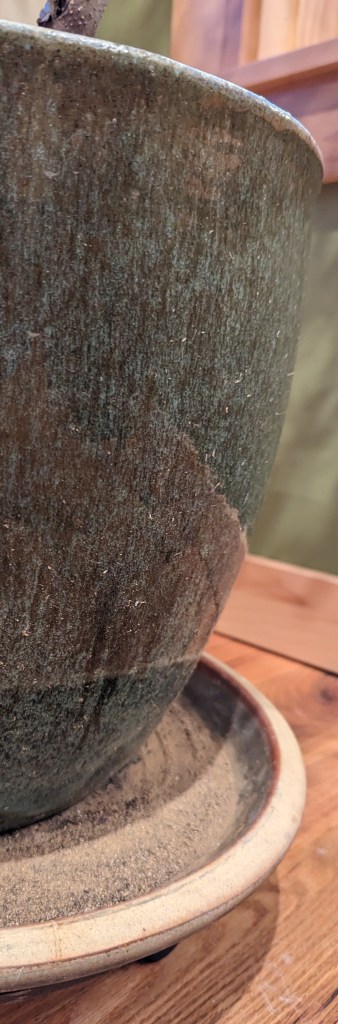
But the visiting minister was chill. And he had engaging things to say. Owen was able to override the anxiety-that-becomes-hitting, pulled it together, and we followed the unspooling of thoughts. Asked to picture an object that might be seen as carrying a message to me of something deeper, I studied a large ceramic planter on the floor near the window. It looked just like the kind of thing that Edward would tell me not to try to move by myself. It stood on a rolling tray.
I studied that pot, feeling certain that the massive form held something for me to get.
So many things in my life feel so very heavy. The challenges before me feel insurmountable, frightening. That’s if I peer in at my inner self. Usually I keep that door closed, just keep threading my way across the chasm on the swinging rope bridge, and don’t look down. The day to day challenges of assisting a person who needs a great deal of support to get through life can be fatiguing, but that isn’t it. It’s the larger question of how to keep our educational organization Real Voices of Philly (realvoicesphilly.org) alive and independent, and how to create a home for Owen with a small group of typers and spellers, so he can age with friends. Able to communicate his thoughts. Able to do his writing. Funded. Cared for kindly. Safe from predators….
I have no idea how to do those things. I never got training in those things, and more than that, it isn’t what I wanted to do with my life. I know that as Edward and I are setting it up we will be told over and over “that is too heavy for you” and “you can’t/aren’t allowed to do that.”
And the other truly frightening thing – what if my partner in crime, who understands the financial side of the undertaking so much better than I, moves out of this world before we figure it out? How can I possibly navigate this enormous problem solo? (As I am writing this I can feel my blood pressure rise.)
The huge heavy pot sits on a little tray with casters. I don’t remember what was growing in it. I visualize the big clay pot. Something that the minister says reminds me of the history of the wheel – an ancient invention. One of the earliest. A way to carry very heavy objects that has been with us for a long, long time. The tool is there. It is literally right underneath, waiting to be put to use.
Sitting in that room, on the edge of my chair with my backpack on and waiting for Owen to fall apart, I take a deep breath. I believe this pot’s message. What I need to carry my burden is already there. It is under my feet. Start with this room of caring individuals, and the two ministers who lead the group – they all make a space for Owen, and are interested in his thoughts.
And in my life this spring, it is true – remarkable things have happened. People I never dreamed existed have shown up in our lives. Ever since we moved to the Philadelphia area people have arrived seemingly out of nowhere. Even though we spent many days of terrible anxiety or exhaustion, uncertain we could keep it up, actually helpers did arrive. This fall even more people have come out of nowhere, enthusiastic for the mission, presuming without difficulty the intelligence of our non-speakers. Wanting to learn to support communication. Able to take in stride and with compassion the behaviors that autism brings.
Not really out of nowhere. I had to ask. I had to push against the weight – reach out for help. Write a message, find time to follow up. Sometimes ask again. Organize my life better, organize my thoughts. Write a proposal to be able to ask more specifically. I had to talk people through things. Let go of some things.
But, I am not alone. There are now other parents, other students, more teachers, and helpers, aides for just Owen and also for the organization that gives him something meaningful to do with his life. That prayer that I used to say, that if this was meant to happen then it would be you God doing it, because I couldn’t, I couldn’t, I couldn’t possibly do this lift…that prayer seems to be answered. Maybe it IS meant to be.
Because now I see that the heavy pot once rolling, could take new form, could transform. Become a huge hot air balloon lifting the weighty basket of beloved people. Fueled properly, perhaps it rises, independent, airborn, and floats slowly upward, while I shade my eyes watching, in awe.
Written in the camper, on the return drive from Treasure Island, FL. March 2023
On this morning, just before we left, Owen spun out of the beach house at an early hour – I found him just down the road, at the center of police cars and ambulances. He was unhurt, but had things to say.
Wystan: Want to spell or to type?
Owen: “Sp”
Owen: “That was frustrating when the police got my hands and put those handcuffs on my wrists.”
W: They seemed like pretty nice guys to me. What do you wish would have happened differently?
O: ” I wish they would only use handcuffs if a person is not listening.”
W: Maybe he thought you weren’t listening? Maybe that’s what they just do for everyone who looks like a robber? Until they know better?
[Owen pulls the card out of my hands, sets it down and won’t talk]
O: “I was not a dangerous person. I was eating their– ” [disrupted movement, small smile]
W: Yeah, what WERE you eating btw?
O: “- their cookies. And chocolate.”
W: Sometimes people are on drugs, and do very strange things, like that guy Dad saw on the beach. But also could be suddenly violent. I am guessing the police see stuff like that. They don’t know what might happen.
O: “It hurts my feelings [bang, bang, bang] that they would think–”
[Big meltdown here]
W: We don’t know what they think. I’m just trying to help you see the situation through other people’s eyes, to help you understand what you experienced.
Would you like to keep processing this?
O: “Y”
W: If you were a policeman, called to a situation like that, seeing a guy in someone’s kitchen early in the morning, a guy who did not speak or answer questions, what would you do? What would you like police people to know about how to handle non-speakers?
O: “I would not have the handcuffs out. I would stay calm and I guess I wish I could talk.
W: Do you mean you wish the police people knew that you wished you could talk?
O: “Yes. Every day every minute of every hour.”
[After a break]
W: So what happened when you got up out of bed this morning?
O: “I was worried about getting into the kitchen again so I went out because that door is easy to open.”
W: I have a question about that. Is it true that you are trying not to break through the locks that we put up? Like do you know how to open them, but you’re trying not to open them? How come you can open things sometimes, but not other times?
O: “Because sometimes it is harder to make my body listen” [Owen starts laughing]. “Sometimes I want–” [more laughing]
W: Does your laughing really mean laughing right now?
O: “Y”
O: [he continues laughing] “–to get out. And most times –”
[Owen pulls the card away from me and sets it down.]
[Next day]
W: Do you want me to start w a question?
O: N
[Owen continues to move and sort plastic bags]
W: Would you like to ask me a question?
O: It is hard to write because we have been going so long in the camper that it makes me feeel really deterred from moving.
W: Interesting choice of words. Seems like there’s so little we know about dysregulated movement, or why there would be this separation of cognitive function from muscular function.
O: Yes. I have very little real control of my body.
[Next day]
W.: Could you describe how getting resistance, or resistive pressure, helps you?
O: it is like havinbg really the wonderful feeling of moving your arm the way you mean it to go. i feel like i cant move.
W: Yes, I have seen you get stuck. But sometimes you move very fast, too.
O: i have a hard time with both things . how to not move is just as hard as moving.
W: Here is part of a conversation that we had a while ago, on this same subject:
W: Do you remember the time before May 2018, before you first spelled?
O: yes i do. it was reallly terrible. i would standn at the counter and no one couuld ask what i wanted. to eat.
W: Do you remember being fed foods that you did not want to eat?
O: yes it happened a loyt [lot]. i hated eggs and green pepers, and yoiu gzagve them to me so many times. they made me sick. i hafd sto,macnh avchdes [aches].
W: Yeah, I remember that you would burp a lot, getting on the school bus. I thought I was giving you a sturdy breakfast. Some people might not understand why you would eat something, if you disliked it so much.
O: i wsas hungry and you did not give me another fchoice but if you gave me eggs today i would still eat them, beca8use i cannnt sgtop mysrrelggfg [myself]. my body iis not able to stop eating whatever i see .
W: Thanks for providing these insights O. Do you have any last thoughts?
O: it matters that we non-speakers have a voice in the world. the world does not believe that we reallllly are thinking people…but we have brains trapped inside bodies that act crazy. people need to get to even know us.
♥️ ♥️ ♥️ ♥️ ♥️
Owen’s words are literally, word for word, letter for letter, what he spelled out. When he was spelling on a letterboard (in the moving camper), I transcribed it so it is in standard spellings and capitalizations. When he was typing on his keyboard the text is as he typed it. As he describes, when getting started, or tired, or in a state of high emotion, he has a much harder time with accuracy, and even staying in the chair at all. It is a great effort – and I feel so lucky to know him, and all the other wonderful young people who spell and type who have come into our lives. This interview took place over several days.
For more on this subject, read Owen’s post about getting into garbage: “Pica Hell” January 27, 2020
Owen and I are painting together in the Quarry Road Center, a special room in our house. We are “painting together” in the sense of dancing together, where one is the star and the other guy the prop. Being a good prop for Owen’s movements has been my study for three years now. The goal of the whole project is to work myself out of a job.
Owen has been claiming greater and greater control of his arm and fingers. When typing he now points his forefinger independently. And moves his arm forward with light resistive pressure under his elbow about 80% of the time.
But holding a brush for painting is another matter. Another neutral pathway? a much more complex set of movements? Or is it because he desperately wants to do it? His hand is limp, barely able to grasp the brush. The painting is interrupted by Owen’s random body movements, also by my grabbing up a painty communication card so he can spell the answers to my questions, so I can correctly understand what he is trying to make his body do. What color next? Where on the page? What kind of mark do you want? How wide a mark? A tedious process only better than not painting it all.
So around and around the room he eddies instead, trying to fight his way back to the paper tablet with his half finished painting on it. And I wait. He wraps and unwraps silky golden ribbon around a glass, around rock, plastic, wood, metal. His movements become only faster as my irritation with him grows.
Like Mozart’s father. Like every other sick parent out there. It doesn’t work. But it is real.
I am too invested, clearly. I want to see you paint, Owen. I want to see what color you will select. What direction you will take this new piece. I also want to feel that the sacrifice of my own time is justified by your production.
Yoga and deep breathing are my friends. Drop shoulders. Let go of control. Release the irritation. Live longer.
Regardless of his other issues Owen’s boundaries are too good to allow being guilted into anything. He will repel my physical “support” if I cross too far over the psychological space between us.
It is good, it is healthy, that Owen is irritated with me. Lately he is irritated all the time. He is lonely. He is constantly frustrated by his own impulsivity – by his lack of body control, his lack of autonomy, his lack of friendships. He is frustrated by his own frustration.
I am also slowly learning to recognize the boundaries between us. Owen is running Owens’ life, on the inside if not on the outside. If my son is unhappy, I don’t need to be unhappy. His life is his own. He is allowed to be eaten up by hated of it, or try to make of it the best he can.
When last we painted, something was different. Owen picked up the card because he had directions to give me. He picked up a tube of color because he really wanted to paint with it. And his grip on the brush was stronger. Purposeful moments. I hold my breath. A huge tiny step forward, as exciting as the painting he generated that afternoon.
A couple weeks later we are at an Art Museum. Owen’s body is full of dysregulated movement as we study massive canvasses by Salvador Dali. An average onlooker would never guess that he wants to be there. He pulls away, toward tiny scraps in the floor, as his dad and I grasp his backpack straps tightly to keep him standing still. The guards eyeball him, although kindly. They have been trained to be “autism friendly.” Still, it’s stressful.
TheDali Museum, St Petersburg, FL
Afterwards, as we sit all three exhausted at a cafe table, I check in. Did you like it? “Y” Which one did you like best? Owen grins. “Abe”. Ahhh.
“Gala Contemplating the Mediterranean Sea which at Twenty Meters Becomes the Portrait of Abraham Lincoln – Homage to Rothko.”
Never underestimate a young person with dysregulated body movement. I bet every one has an inner world painted in brilliant colors, that this world has yet to see.




 Embracing Chaos